

Across Africa and emerging markets, millions of consumers are ready to access life-changing products through financing — smartphones, solar systems, clean cooking, e-mobility, productive assets, and financial services.
Demand is not the problem. Infrastructure is.
Every ambitious lender, asset financier, MFI, and PAYGo operator eventually reaches the same crossroads: Do we build our own platform, or do we use an established one?
For many leadership teams, the instinct is the same: “Let’s build it ourselves.”
It feels strategic. It feels like control. It feels like ownership.
But for most businesses, it becomes the single most expensive operational decision they make.
Because what starts as “building a platform” quickly turns into building a payments engine, a collections system, a field operations network, a device management stack, a reporting architecture, a credit intelligence engine, and an internal software company you never planned to run.
And by the time the platform is “ready,” margins are gone, growth is delayed, and your engineering team has quietly become the most expensive collections department in the business.
This is the hidden tax of building in-house. And it is destroying scale across emerging markets.
The Illusion of “We’ll Just Build It”
Most companies dramatically underestimate what they are actually trying to build.
They think they need a repayment portal.
What they actually need is: mobile money integrations across multiple providers, real-time reconciliation logic, device lock and unlock automation, arrears workflows, customer communication systems, credit scoring models, field collection tools, offline-first agent applications, inventory tracking, repossession workflows, reverse logistics, audit trails, investor-grade reporting, API integrations, ERP compatibility, access control systems, and infrastructure that can survive low-connectivity environments across multiple countries.
Building software is easy. Building operational infrastructure is not.
Especially in frontier markets where payments are fragmented by design, field teams operate across disconnected geographies, and portfolio performance depends on thousands of daily repayment decisions.
This is why most internally built systems never truly finish.
They evolve into permanent engineering debt.
Engineering Cost Is Only the Beginning
The mistake most operators make is calculating only development cost.
A few developers.
A few integrations.
A few months of work.
That is never the real number. The real cost is maintenance.
It is failed payment integrations.
It is downtime during month-end collections.
It is delayed settlements.
It is poor customer experience.
It is manual reconciliation.
It is weak repossession visibility.
It is broken field operations.
It is investor reporting that takes three weeks to produce manually.
It is losing your Head of Engineering and discovering only one person understands how your collections engine works.
The cost is not what you spend building. The cost is what the business loses while the system struggles to work.
In high-volume financing businesses, even a 1% leakage in collections can destroy margins. Asopo’s own market framing highlights exactly this risk: fragmented mobile money, bank transfers, and field collections create revenue leakage, delayed settlements, and almost no real-time financial visibility.
That is not a software problem. That is a business survival problem.
What You Are Really Buying
When companies evaluate platforms like Asopo, they often ask:“Why shouldn’t we just build this ourselves?”
The better question is: “How much engineering, operational risk, and lost growth are we paying to avoid?”
Asopo is not a lightweight SaaS tool.
It is the commercialisation of Pulse — an operating system originally built to run one of Africa’s most sophisticated distributed financing businesses.
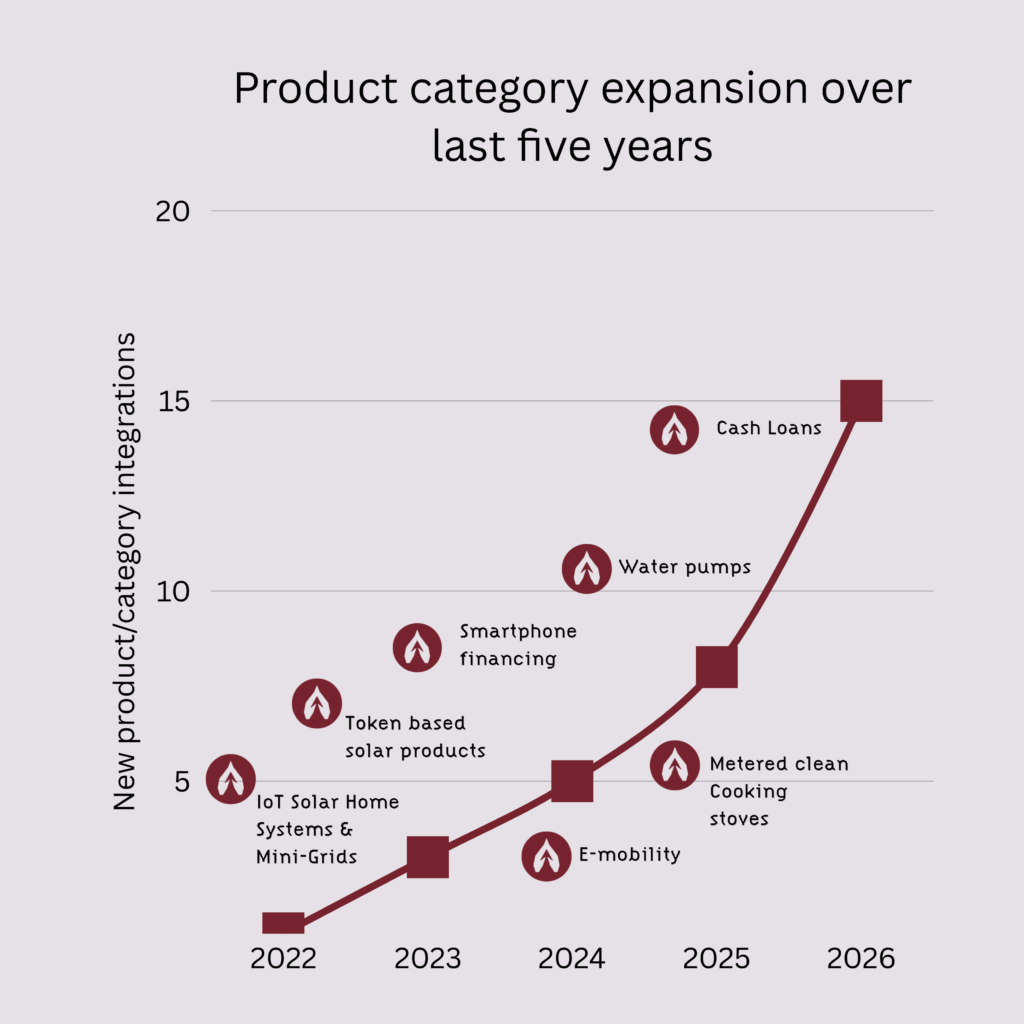
It has already processed more than 100 million mobile money transactions, managed more than 1 million financed products, supported 10,000+ field agents, and maintained 99.9% platform uptime across 10+ African markets.
That means you are not buying software.
You are buying more than a decade of engineering, integrations, operational learning, and failure already solved.
That is the real product.
Payments and Credit Intelligence
Most financing businesses are not short of repayments.
They are short of visibility.
Payments arrive across mobile money providers, banks, cards, and field collections. Reconciliation becomes manual. Credit decisions become reactive. Collections become expensive.
Asopo centralises all transaction flows into a single reconciled system with real-time mobile money integrations, automated reconciliation, revenue recognition, and device lock/unlock logic .
Its behavioural credit engine continuously analyses repayment behaviour, refreshes credit scores, segments portfolios, and automates arrears workflows .
No need to build your own collections engine.
No need to build your own credit intelligence stack.
No need to discover too late where your portfolio risk actually lives.
Asset and Device Lifecycle Management
Financing 5,000 assets is manageable.
Financing 500,000 becomes controlled chaos.
Without lifecycle visibility, scale creates blind spots.
Device status becomes unclear.
Repossession breaks down.
Recovery value disappears.
Write-offs rise quietly.
Asopo provides real-time device control, serial number tracking, warranty workflows, reverse logistics, refurbishment visibility, and complete lifecycle management from activation to final repayment.
Every asset becomes measurable.
Every recovery becomes intentional.
Every portfolio becomes investable.
Last-Mile Logistics and Field Operations
Distributed agents are often the backbone of financed businesses.
They are also often the largest hidden cost centre.
Disconnected apps, unreliable offline tools, and manual task management create inconsistent collections, poor accountability, and silent EBITDA erosion.
Asopo’s Field Service layer connects agents, technicians, and field teams through offline-first applications, real-time task orchestration, inventory visibility, and performance dashboards.
Field operations stop being operational guesswork.
They become measurable infrastructure.
Customer Lifecycle and Revenue Expansion
The best financed businesses do not only acquire customers.
They expand customer lifetime value.
They upgrade.
They cross-sell.
They bundle.
They retain.
Most internal platforms fail here because they were built for one product, not an ecosystem.
Asopo supports multi-product billing across days, kWh, subscriptions, loans, devices, and bundles, alongside automated customer engagement and retention workflows.
That means operators can launch new financed products without rebuilding the stack every time strategy evolves.
Growth stops becoming operational debt.
Enterprise-Grade Architecture and Reporting
Investors do not fund spreadsheets.
They fund visibility.
Institutional lenders, strategic partners, and boards require operational discipline, auditability, and confidence.
Asopo provides advanced dashboards, historical analysis, ERP integrations, audit trails, and enterprise-grade reporting built for high transaction environments.
Because confidence is not built through promises.
It is built through reporting.
Flexible Platform Architecture
The strongest technology strategy is rarely replacement.
It is integration.
Most businesses do not want to rip out everything they already have. They want infrastructure that works with what already exists.
Asopo is built on modular microservices architecture and API-first deployment, allowing businesses to deploy the full platform, integrate individual modules, or expand functionality over time without disruptive migrations.
You do not need to rebuild your business.
You need to remove the friction slowing it down.
The Best Engineering Teams Don’t Build Everything
The smartest operators understand one thing: Not everything should be proprietary.
Your competitive advantage is not reconciliation logic.
It is not mobile money integrations.
It is not device lock APIs.
It is not collections workflow infrastructure.
Your advantage is your customers.
Your underwriting.
Your distribution model.
Your market.
Your speed.
Build there. Not in the backend.
The best engineering teams do not build everything. They decide what should be owned — and what should already exist.
That is where real scale happens.
Final Thought
If your roadmap includes building payments infrastructure, collections systems, field operations tooling, and credit intelligence from scratch— you are not building a financing business. You are building a software company.
And there is a better way.
Asopo exists so you do not have to.
Because the future of financed businesses will not be won by the companies with the biggest engineering teams.
It will be won by the companies that scale fastest, collect smartest, and operate with the least friction.
That is what infrastructure is for.
That is what Asopo was built to do.