
The First Decision Is the Most Important One

In lending and asset financing, every portfolio begins with a simple decision: Who do you choose to serve?

In developed markets, this decision is supported by mature identity systems, credit bureaus, and structured financial histories.

In emerging markets, it is not.

Instead, lenders and operators must make onboarding decisions in environments where identity systems are fragmented, documentation is inconsistent, and financial behaviour is largely invisible at the point of entry.

The result is a structural weakness that sits at the very foundation of the portfolio.

Risk is introduced before the first repayment is even made.

A System Not Designed for the Markets It Serves

Across Africa and other emerging economies, the scale of the challenge is significant.

According to the World Bank, over 1.4 billion adults globally remain unbanked, many of whom rely on informal or mobile-first financial systems.

At the same time, the GSMA reports that mobile money has become the dominant financial channel in Sub-Saharan Africa, processing hundreds of billions of dollars annually.

These systems have unlocked access — but they have not solved onboarding.

Traditional KYC processes remain:

  • Manual
  • Time-consuming
  • Inconsistent across markets
  • Disconnected from financial behaviour

In practice, this means lenders are often answering only one question:

👉 “Is this person real?”

While missing the more important one:

👉 “Is this person likely to repay?”

The Hidden Cost of Weak KYC

When onboarding lacks depth, the impact is not immediate — but it is inevitable.

Weak KYC leads to:

  • Fraudulent or duplicate identities entering the system
  • Poor borrower selection at the point of origination
  • Higher first-cycle defaults
  • Increased operational cost in collections
  • Reduced confidence in portfolio quality

Over time, this compounds.

Collections teams work harder.

Credit models become less reliable.

Portfolio performance begins to deteriorate.

What appears to be a collections problem is often an onboarding problem in disguise.

From Verification to Intelligence

What is emerging now is a shift in how leading operators think about KYC. It is no longer sufficient to verify identity. KYC must evolve into a system that combines:

  • Identity validation
  • Financial behaviour analysis
  • Continuous risk assessment

This is the transition from static KYC → dynamic KYC.

In this model, onboarding is no longer a checkpoint. It becomes the first layer of a broader credit intelligence system.

The Asopo Perspective: KYC as Infrastructure

This is the lens through which Asopo Technologies approaches the problem.

At Asopo, KYC is not treated as a standalone feature. It is embedded into the operational infrastructure that connects onboarding, credit, payments, and portfolio management.

The platform combines multiple layers of intelligence at the point of onboarding.

First, identity is verified through integrations with digital identity providers such as Smile Identity, enabling real-time document validation and facial recognition. This ensures that customers are accurately identified before any financial product is issued.

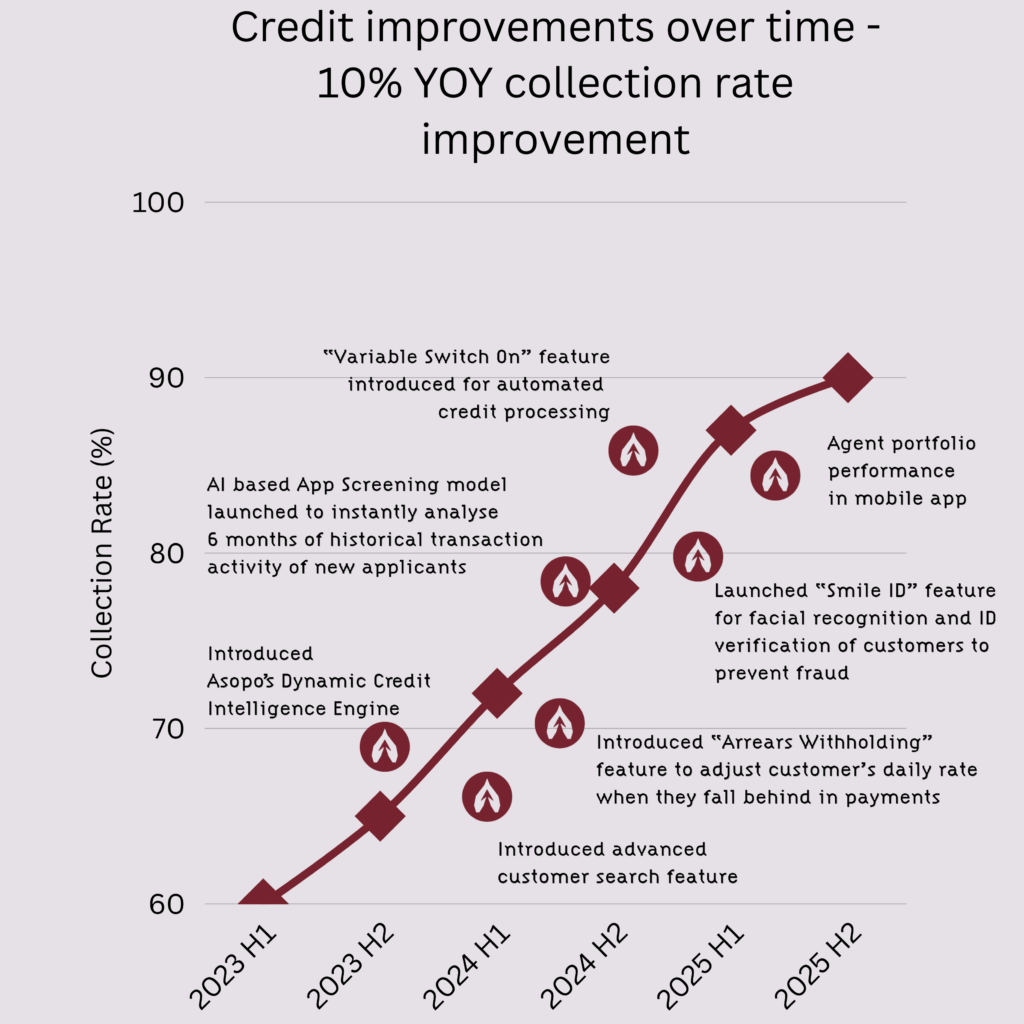
Second, Asopo extends KYC beyond identity through AI-powered application screening. By analysing 3 to 6 months of mobile money transaction data, the platform evaluates income patterns, spending behaviour, and liquidity signals — providing a real-time assessment of financial stability.

This allows operators to move from basic verification to data-driven underwriting decisions.

Third, onboarding feeds directly into a continuous credit intelligence layer. As repayment behaviour begins, risk profiles are updated dynamically, early warning signals are detected, and portfolio segmentation becomes more precise.

The result is a system where KYC is not a one-time action. It is the starting point of a continuously evolving understanding of customer risk.

Why This Matters for Credit Performance

The impact of this shift is measurable.

When onboarding is built on intelligence rather than verification alone:

  • Portfolio quality improves from day one
  • First-cycle defaults decrease
  • Collections become more targeted and efficient
  • Credit models become more accurate over time

This creates a compounding effect across the portfolio.

Better onboarding leads to better repayment behaviour. Better repayment data leads to stronger credit intelligence. Stronger intelligence leads to better decisions.

And the cycle continues.

The Future of KYC

As lending and asset financing models continue to expand across emerging markets, KYC will no longer be defined by compliance requirements alone.

It will be defined by its impact on performance.

Operators that continue to treat KYC as a manual, isolated process will struggle with:

  • rising defaults
  • inconsistent portfolio quality
  • increasing operational complexity

Those that adopt a more integrated, intelligence-driven approach will be able to:

  • reduce risk at origination
  • improve portfolio predictability
  • scale with greater confidence

Closing Thought

In emerging markets, the biggest risk is not who you fail to serve. It is who you choose to onboard without understanding.

Because in the end, credit performance is not built at collections. It is built at the very first decision.

A System Built to Track — Not to Understand

Across emerging markets, asset financing has become a cornerstone of economic access. From solar home systems and smartphones to clean cooking solutions and electric mobility, millions of consumers now access essential products through financed models.

Over the past decade, operators have invested heavily in digital infrastructure to support this growth. Systems have been deployed to track assets, record payments, and manage customer portfolios.

On paper, this represents progress. In reality, it has created a new limitation.

Most platforms were designed to track assets — not to understand them.

And as asset finance scales, that distinction becomes critical.

The Limits of Tracking in a Dynamic Environment

At small scale, asset tracking is sufficient.

Operators can monitor where devices are, whether payments are being made, and which customers are active. Basic visibility provides a sense of control.

But as portfolios grow — across markets, products, and customer segments — the nature of the problem changes.

Assets are no longer static. They move through a lifecycle:

  1. Activation
  2. Usage
  3. Repayment
  4. Risk
  5. Recovery
  6. Redeployment

Each stage generates signals. Each signal carries meaning.

Yet in most systems, these signals remain fragmented — captured in different tools, disconnected from one another, and rarely translated into actionable insight.

The result is a growing gap between data and understanding.

The Cost of Not Understanding the Lifecycle

This gap has real financial consequences.

Without a connected view of the asset lifecycle, operators struggle to answer fundamental questions:

  1. Which assets are becoming high-risk — and why?
  2. When should a customer be upgraded, retained, or recovered?
  3. What is the true recovery value of a repossessed asset?
  4. How efficiently is capital being deployed across the portfolio?

Instead, decisions are made reactively.

Repossession happens late.

Upgrades are mistimed.

Assets are underutilised or lost.

These inefficiencies compound over time, quietly eroding margins.

According to GOGLA, PAYGo and asset-financing models across Africa have enabled access to energy and productive assets for tens of millions of people — but they also highlight the increasing need for robust operational systems to manage assets, payments, and customer relationships at scale.

As portfolios grow into the hundreds of thousands — or millions — of assets, the challenge is no longer access.

It is control.

From Tracking to Lifecycle Intelligence

What is emerging now is a shift in how leading operators approach infrastructure.

Asset tracking is no longer enough.

The focus is moving toward lifecycle intelligence — the ability to capture, connect, and interpret signals across every stage of an asset’s journey.

This requires a different kind of system.

One that does not treat payments, devices, and customer behaviour as separate data streams — but as part of a unified operational model.

When these signals are connected, a new layer of intelligence becomes possible:

  1. Payment behaviour informs asset risk
  2. Usage patterns inform upgrade potential
  3. Lifecycle stage informs recovery strategy
  4. Portfolio data informs capital allocation

In this model, assets are no longer passive units to be tracked. They become active sources of insight.

The Asopo Perspective: Infrastructure That Understands Assets

This is the shift that Asopo Technologies has been built to enable.

Originally developed within Bboxx to manage large-scale distributed operations across multiple African markets, the Pulse platform was designed not just to track assets — but to operate them at scale. Today, Asopo brings that same capability to a broader ecosystem of asset financiers, lenders, and operators.

At its core, the platform integrates payments, asset lifecycle management, and customer behaviour into a single operational layer.

This allows operators to move beyond fragmented visibility and towards a continuous, real-time understanding of their portfolios.

Across the lifecycle, Asopo provides:

  1. Real-time device monitoring and control, including activation, deactivation, and payment-linked enforcement
  2. Serial-level asset tracking, ensuring full traceability from onboarding to recovery and redeployment
  3. Structured lifecycle workflows, covering repossession, refurbishment, and asset reuse
  4. Payment compliance integration, linking repayment behaviour directly to asset status and risk
  5. Portfolio-level visibility, enabling operators to track performance, recovery rates, and asset utilisation across markets

This is not simply asset tracking. It is lifecycle intelligence embedded into infrastructure.

The platform has been tested at scale — managing over 100 million mobile money transactions and more than one million financed products across multiple African markets— generating the depth of operational data required to continuously refine these intelligence models.  

For operators, this creates a fundamental shift.

Every asset becomes visible.

Every lifecycle event becomes measurable.

Every decision becomes more informed.

The Next Phase of Asset Finance

As asset finance continues to expand across emerging markets, the next phase of growth will not be defined by how many assets are deployed.

It will be defined by how effectively those assets are managed over time.

Operators that rely on tracking alone will struggle with complexity, inefficiency, and declining margins.

Those that adopt lifecycle intelligence will be able to:

  1. Detect risk earlier
  2. Optimise recovery and redeployment
  3. Increase asset utilisation
  4. Deploy capital more efficiently

In doing so, they will build more resilient, scalable, and investable businesses.

Closing Thought

Asset finance has already transformed access. The next transformation will be operational.

Because in the end, the difference between tracking an asset and understanding it…is the difference between managing growth and losing control of it.

 A System Built for Scale — Without the Infrastructure to Support It 

Across emerging markets, a new financial system is being built in real time. 

It does not rely on bank branches or traditional credit histories. Instead, it is powered by mobile money, distributed agent networks, and millions of small, recurring payments. Through this system, consumers are gaining access to smartphones, energy, mobility, and essential services — often for the first time. 

On the surface, the model appears to be working. Adoption is accelerating. Capital is flowing. New business models are emerging at speed. 

But beneath this growth lies a more fragile reality. 

The infrastructure required to support these systems at scale has not kept pace with their expansion. And as a result, many asset finance businesses are scaling faster than their operational foundations can support. 

According to the World Bank, over 1.4 billion adults globally remain unbanked, with mobile money rapidly becoming the primary financial interface in many regions. Meanwhile, the GSMA estimates that Sub-Saharan Africa alone processes hundreds of billions of dollars in mobile money transactions annually. 

This shift has created unprecedented access. It has also created unprecedented complexity. 

Scaling the Model — And Exposing Its Limits 

For asset finance operators, complexity is not theoretical. It is operational. 

Every financed asset introduces a continuous stream of activity — payments across multiple channels, customer interactions, servicing events, and evolving credit risk. At small scale, these systems can be managed with basic tools and manual processes. 

At scale, they begin to break. 

What once felt like growth starts to feel like strain. Visibility diminishes. Processes fragment. Decision-making slows. And the gap between what is happening in the field and what is visible at the centre begins to widen. 

Payments: The First Point of Failure 

The first cracks typically appear in payments. 

In most emerging markets, payment ecosystems are inherently fragmented. Customers transact through mobile money platforms, agent networks, bank transfers, and card systems — each operating on different rails, with different settlement cycles and reconciliation requirements. 

What appears externally as a seamless flow of payments is, internally, a fragmented and often inconsistent data environment. 

This fragmentation creates a persistent operational burden. Reconciliation becomes manual. Financial visibility is delayed. Revenue leakage becomes difficult to detect. As transaction volumes increase, so do the costs of managing them. 

In high-volume, low-margin financing models, even small inefficiencies compound rapidly. A single percentage point of leakage can materially erode profitability. 

Yet many organisations continue to manage this complexity using spreadsheets and disconnected systems. 

Credit Without Context 

If payments are fragmented, credit intelligence becomes even more constrained. 

Traditional credit models were not designed for mobile money economies. They rely on static financial histories and assumptions of income stability that often do not hold in these environments. As a result, lenders are left with an incomplete picture of customer behaviour. 

In practice, many continue to rely on basic repayment histories and reactive collections strategies to manage risk. 

But credit risk in these markets is not static. It evolves continuously through behaviour — through how customers repay, when they repay, and how their liquidity changes over time. 

Without the ability to capture and interpret these signals, lenders are forced into a reactive posture. Risk is identified late. Defaults increase. Upgrade opportunities are missed. Capital is deployed inefficiently. 

Over time, the consequences are reflected not only in portfolio performance, but in declining investor confidence. 

Growth Is Not the Problem. Control Is. 

The combination of fragmented payments and limited credit visibility creates a structural constraint on scale. 

Growth, in this context, does not simply increase revenue. It amplifies complexity. And without the infrastructure to manage that complexity, operational strain begins to erode financial performance. 

This is the hidden infrastructure crisis in asset finance. It is not a problem of demand. Nor is it a problem of capital. 

It is a problem of control — specifically, the ability to understand, in real time, what is happening across a portfolio. 

From Fragmentation to Intelligence 

Addressing this challenge requires more than incremental improvements. It requires a shift in how asset finance businesses think about infrastructure itself. 

Payments can no longer be treated as isolated transactions. Credit can no longer be reduced to static scores. 

Instead, both must be integrated into a unified intelligence layer — one that continuously translates operational data into actionable insight. 

When payment behaviour is captured and analysed in real time, it becomes a powerful signal of customer reliability, portfolio health, and emerging risk. 

This is where payments and credit converge. 

And it is this convergence that defines the next generation of financial infrastructure. 

The Asopo Perspective: Infrastructure That Thinks 

This is the lens through which Asopo Technologies approaches the problem. 

At Asopo, the focus is not simply on digitising operations, but on embedding intelligence directly into the operational backbone of financed businesses. The platform integrates payment flows, customer lifecycle data, asset performance, and behavioural analytics into a single system — eliminating the fragmentation that prevents organisations from fully understanding their portfolios. 

“In asset finance, the problem isn’t collecting payments — it’s understanding what those payments are telling you about your customers, your risk, and your business in real time.” 
— Christopher Baker-Brian, MD, Asopo Technologies 

Within this unified infrastructure, payments are automatically reconciled across channels, creating a consistent and real-time view of financial performance. More importantly, repayment behaviour is continuously analysed to generate dynamic credit intelligence. Instead of relying on static risk models, operators gain access to behavioural scoring systems that evolve alongside their customers. 

This intelligence is operational. It informs how collections are prioritised, how repayment strategies are adjusted, how upgrades are timed, and how capital is deployed across the portfolio. 

At scale, these decisions compound. 

The platform has already processed over 100 million mobile money transactions and managed more than one million financed products across multiple African markets — generating the behavioural data required to power this intelligence layer.  

For asset financiers, this represents a fundamental shift. Payments are no longer just financial events to be recorded. They become signals — inputs into a continuously improving understanding of customer behaviour and portfolio performance. 

The Companies That Scale Will Be the Ones That See 

As financed economies continue to expand, the organisations that succeed will not be those that deploy the most capital. 

They will be those that build the deepest visibility into their operations. 

They will unify fragmented systems. 
They will convert payment behaviour into credit intelligence. 
They will make decisions based on real-time insight rather than delayed reporting. 

Because in asset finance, scale is not defined by how many assets you deploy. 

It is defined by how clearly you can see what is happening across them. 

Closing Thought 

The infrastructure gap in asset finance is already visible. 

The companies that recognise it — and build intelligence into their operations — will be the ones that scale. 

Across emerging markets, a quiet financial revolution is underway. 

Millions of consumers who were previously excluded from traditional banking systems are now accessing products, services, and economic opportunities through digital payments and financed assets. Smartphones, solar energy systems, e-mobility devices, clean cooking solutions, and connectivity services are increasingly financed through small, flexible payment plans. 

But behind this growth lies a critical challenge: traditional lending infrastructure was never designed for mobile money economies. 

The next generation of lending will not be built on credit bureaus alone. 
It will be built on payment intelligence. 

The Rise of Mobile Money Economies 

In many emerging markets, mobile money has become the primary financial infrastructure. 

According to the GSMA State of the Industry Report on Mobile Money, there were over 640 million registered mobile money accounts in Sub-Saharan Africa in 2023, with the region processing more than $800 billion in transaction value annually. Mobile money now represents one of the fastest-growing financial ecosystems globally. 

This shift has fundamentally changed how financial activity is recorded and understood. 

Instead of bank statements and formal credit histories, millions of consumers transact through: 

  • mobile money wallets 
  • peer-to-peer transfers 
  • merchant payments 
  • agent cash-in and cash-out networks 

These transaction flows generate an entirely new form of financial data — behavioural payment data. 

And this data holds the key to the future of lending. 

Why Traditional Credit Models Fall Short 

Conventional credit scoring systems were designed for economies where borrowers typically have: 

  • stable salaried income 
  • formal bank accounts 
  • long credit histories 

In emerging markets, those assumptions rarely hold true. 

Many borrowers operate within informal economies, where income can fluctuate seasonally and financial activity happens through digital wallets rather than banks. 

As a result, lenders relying solely on traditional credit metrics often face three structural problems: 

  1. Limited visibility into customer behaviour 
  1. Delayed detection of credit risk 
  1. Inefficient allocation of capital 

This is why lenders across Africa are increasingly exploring alternative data sources to assess creditworthiness. 

According to the Fintech Association of Kenya, digital lenders are rapidly expanding the use of mobile transaction data, behavioural analytics, and AI-driven models to better evaluate borrower risk in mobile-first economies. 

The future of credit in these markets will depend on how well lenders understand real financial behaviour. 

Payments Are the Most Powerful Credit Signal 

Every repayment contains valuable insight. Not just whether a customer paid — but how they paid. Payment behaviour can reveal: 

  • consistency of repayment habits 
  • liquidity cycles and income patterns 
  • willingness to prioritize loan repayment 
  • early warning signals for potential default 

Across thousands or millions of repayments, these signals form a powerful dataset that can be used to build behavioural credit intelligence models. 

This approach moves lenders beyond static risk scoring toward dynamic portfolio intelligence. 

Instead of reacting after a payment is missed, lenders can detect risk signals earlier and intervene before defaults occur.

From Transaction Data to Credit Intelligence 

To unlock this capability, lenders need infrastructure capable of processing high volumes of payment data across fragmented financial ecosystems. 

Mobile money providers, card networks, banking rails, and field collections often operate independently — producing fragmented datasets that are difficult to reconcile. 

Modern lending infrastructure must therefore do more than process payments. 

It must transform payment activity into actionable intelligence

Platforms like the Asopo have been built specifically for this environment. By integrating mobile money payments, asset tracking, and behavioural analytics into a unified platform, operators can turn millions of repayment transactions into dynamic credit insights. 

With the right infrastructure in place, repayment data becomes a strategic asset rather than a simple operational record. 

Payment Intelligence as the New Financial Infrastructure 

The shift toward payment intelligence has profound implications for the future of lending. 

Lenders that can analyse repayment behaviour effectively will be able to: 

  • identify credit risk earlier 
  • optimise collections strategies 
  • segment portfolios more intelligently 
  • unlock new lending opportunities 

Most importantly, they will be able to extend credit to customers who were previously considered “unscorable.” 

This is particularly important in emerging markets, where millions of consumers remain outside traditional credit systems but actively participatein digital payment ecosystems. 

By leveraging behavioural payment data, lenders can responsibly expand financial inclusion while maintaining portfolio performance. 

Building the Next Generation of Financed Economies 

The growth of financed products across emerging markets is accelerating. 

From smartphones and solar energy systems to electric mobility and digital connectivity, asset financing is becoming a core mechanism for economic access. 

But scaling these ecosystems requires more than capital. 

It requires data-driven infrastructure capable of understanding how customers interact with financial services in real time. 

Payment intelligence will become the foundation of this infrastructure. 

Because in emerging markets, the most reliable indicator of creditworthiness is not a credit report. 

It is the behaviour behind every payment

From Payment Data to Payment Intelligence: The Asopo Perspective 

The shift toward payment intelligence requires more than new scoring models. It requires infrastructure capable of capturing, analysing, and operationalising payment behaviour at scale. 

In many emerging markets, payment ecosystems are highly fragmented. Mobile money providers, banking rails, card networks, and field collections often operate independently, generating datasets that are difficult to reconcile and even harder to analyse in real time. 

Without unified infrastructure, the full value of payment data remains locked inside disconnected systems. 

At Asopo, we believe payment intelligence must be embedded directly into the operational backbone of financed businesses. 

The Asopo platform integrates mobile money transactions, customer lifecycle data, and financed asset performance into a single operational layer. This unified infrastructure allows operators to move beyond simply recording payments and begin extracting meaningful intelligence from repayment behaviour. 

Across the platform, payment data feeds into several key decision systems: 

• Behavioural credit scoring, continuously analysing repayment patterns to identify early risk signals and segment portfolios more effectively. 

• Dynamic portfolio monitoring, enabling operators to track payment compliance, arrears behaviour, and liquidity cycles in real time. 

• Predictive cash flow forecasting, helping businesses anticipate collection performance and manage working capital more efficiently. 

• Operational decision support, allowing customer service, collections, and credit teams to access clear insights into each customer’s repayment behaviour. 

By transforming raw transaction flows into structured operational intelligence, payment data becomes more than a record of past activity. It becomes a forward-looking decision engine that improves credit performance and strengthens portfolio resilience. 

This approach has already been proven at scale. The platform has processed over 100 million mobile money transactions and managed more than one million financed products across multiple African markets, generating the behavioural data needed to power these intelligence models.  

For asset financiers, this means that every repayment contributes to a continuously improving understanding of portfolio health. 

In other words, payments stop being a collections process — and become a source of strategic financial intelligence. 
 
The future of lending in emerging markets will not be defined solely by access to capital. It will be defined by access to intelligence. As mobile money ecosystems continue to expand, the organisations that succeed will be those that transform payment behaviour into real-time credit insight. In these markets, the most valuable financial signal is not a traditional credit report. It is the pattern behind every repayment. 

Asopo Technologies is proud to share that Kashif Mir Mazer Ali, Lead Data Architect, has been awarded Best Data Architect – Energy Sector 2026 at the Energy Evolution Conference in Dubai on the 10th February 2026.

This recognition reflects Kashif’s leadership in strengthening our data infrastructure and building scalable systems that support growth across multiple markets.

Over the past few years, Kashif has led the evolution of Asopo’s data platform — moving from a legacy warehouse setup to a modern, cloud-based architecture using AWS, Redshift, dbt, Airflow, and Power BI. As the lead architect behind our Data Warehouse ecosystem, he has helped establish a reliable, high-performing foundation for operational and strategic reporting.

He also played an important role during the merger integration of PEG Africa and Bboxx, helping unify data systems and ensure reporting consistency and reliability across markets.

Under his leadership:

  • The data platform scaled successfully across 10+ markets
  • Reporting reliability improved to >99.9% uptime
  • Reporting failures were significantly reduced
  • A strong team of seven data professionals was built and developed
  • Overall analytics performance and scalability improved substantially

In addition to receiving the award, Kashif was invited to speak at the conference.

Christopher Baker-Brian, Managing Director, Asopo Technologies, said: “Kashif has been instrumental in strengthening our data infrastructure during a period of rapid growth and transformation for the organisation. His leadership in building a scalable cloud-based platform across seven markets has significantly improved our operational visibility and reporting reliability. This recognition in Dubai is a well-deserved acknowledgment of both his technical expertise and the broader impact of his work.”

About ASOPO Technologies

Asopo Technologies operates Pulse, a software platform supporting asset-financed and distributed business models across Africa. Pulse integrates mobile money, asset tracking, credit operations, and analytics into a unified system that enables scalable growth.

The platform supports millions of transactions each month, connects thousands of field agents through web and mobile tools, and helps organizations improve transparency, operational control, and financing reliability.

Asopo Technologies is part of the Abci-Nexus group.

  • Spinout company targets new partners across the continent
  • Backed by more than 10-year track record in retail and consumer credit software in Africa
  • Bboxx will continue serving customers with essential products and services

Kigali, Rwanda, 29th January 2026 – Abci-Nexus, the technology-enabled holding company, today introduces Asopo Technologies, bringing its proprietary Pulse software to market as a standalone offering. The holding company also includes Bboxx, a retail and consumer credit company focussed on the provision of essential services across Africa.

Building on the legacy of Bboxx built up over 15 years, this latest move by Abci-Nexus marks a major evolution for the group and is designed to accelerate scale, impact, and long-term value creation across its markets.

Under the new company architecture, Bboxx will continue as the group’s retail and consumer credit business, headquartered in Kigali and focussed on serving aspiring urban and underserved rural customers with clean energy, clean cooking, smartphones, e-mobility and selected financial services, using pay-as-you-go and other asset-financing models powered by Pulse.

The new company Asopo Technologies will commercialise and scale Pulse, the group’s fully integrated operating system originally designed to run Bboxx’s distributed operations, into new geographies and across multiple sectors, developing a leading B2B SaaS platform for asset-financed products in growth markets.

Anthony Osijo, Group CEO, Abci-Nexus, said:

“This marks a new beginning for the company. This structure allows each part of the group to focus on what it does best. Abci-Nexus will concentrate on capital, partnerships and governance; Bboxx on delivering reliable products, great service, and meaningful impact for households, businesses, and communities; and Asopo Technologies on building world-class scalable software. By focussing on our strengths in each vertical, we can improve quality and efficiency, scale faster, and further catalyse our impact.”

Pulse integrates mobile money, device and asset tracking, and credit operations into a single AI powered platform, improving customer quality and operational efficiency for Bboxx and its partners. Asopo Technologies takes its name from the Yoruba word for “connection”, reflecting its role in connecting people, data, and finance.

Christopher Baker-Brian, Co-founder and CTO, Bboxx and Managing Director, Asopo Technologies, said:

“Pulse has always been the digital backbone powering Bboxx’s growth for more than a decade, enabling us to build and scale distributed, asset-financed businesses in some of the world’s most complex markets. By spinning it out under Asopo Technologies, we can offer the same infrastructure to other companies. Our goal is to make building and scaling asset-financed businesses in emerging markets dramatically easier, across Africa and beyond.”

Pulse already processes millions of transactions a month, connects thousands of agents, and supports the delivery of clean, affordable energy and connectivity to more than six million people.

Representatives of Abci-Nexus’s shareholder consortium, who include PIDG (Private Infrastructure Development Group) said:

“As long-term investors, we are fully aligned behind this next chapter for Abci-Nexus. Over the past two years we have worked closely with the leadership team to strengthen the group, sharpen its strategic direction, and position it for sustainable growth. The new architecture provides the clarity, focus, and operational discipline needed to unlock the full potential of Bboxx, Asopo Technologies and the wider portfolio. We remain committed to supporting Abci-Nexus as it scales its impact, deepens market penetration, and delivers life-changing products and services to millions more people.”

Abci-Nexus is, through its portfolio companies, already positively impacting the lives of more than six million people in seven operating markets, directly contributing to 12 of the 17 UN Sustainable Development Goals. It is one of the largest retail networks in Africa, with more than 3,000 staff across the continent and support teams in Europe and Asia.

ENDS

Notes to Editors

Media contacts: bboxx@impactandinfluence.global

About Abci-Nexus

Abci-Nexus is a holding company enabled by technology, operating at the convergence of delivering access to energy and essential services; bridging the gap of the underserved with innovative solutions; and connecting communities through digital infrastructure.

We are driving financial, digital and social impact, deeper market penetration, and long-term value creation across emerging economies.

The holding company includes Bboxx, a retail and consumer credit company focussed on the provision of essential services across Africa, and Asopo Technologies, a software company that is powering Africa’s financed future.

Abci-Nexus builds strategic partnerships with investors, utilities providers, global companies, and governments to accelerate growth and provide a wide range of products to consumers in Africa.

About Asopo Technologies

Asopo Technologies operates Pulse, a software platform that is powering Africa’s financed future by integrating mobile money, asset tracking, and credit operations into one seamless platform.

Through its advanced credit scoring, AI-driven analytics, and mobile money integration, Pulse predicts repayment behaviour, tailors flexible payment plans, and mitigates credit risk in markets where formal finance is scarce. This makes inclusive and sustainable growth commercially viable. 

The platform now supports millions of transactions a month, underpins 10,000 agent livelihoods, and has helped deliver clean, affordable energy and connectivity to more than 6 million people. Designed to tackle the structural barriers that make scaling distributed businesses difficult, from last-mile logistics to remote customer management, it connects thousands of field agents via web and mobile, integrates supply-chain and payments data in real time, and enables affordable, pay-as-you-go access to life-changing products and services.

Pulse’s modular, interoperable architecture enables it to automate operations, derisk financing, and integrate seamlessly with enterprise systems, transforming how businesses operate in the world’s fastest-growing economies.

Pulse powers Bboxx, which deploys innovative products across Africa, transforming lives and unlocking potential through services including clean cooking, e-mobility, device financing and household renewable energy.

Asopo Technologies is part of the Abci-Nexus group.

About Bboxx

Bboxx deploys innovative products across Africa, transforming lives and unlocking potential.

Headquartered in Rwanda, Bboxx is championing the economic empowerment of Africa, accelerating the transition to the digital economy, and creating new markets. It has an extensive on-the-ground network to connect consumers with clean energy, clean cooking, smartphones, e-mobility and selected financial products – many for the first time.

Bboxx is powered by Pulse, Asopo Technologies’ fully integrated operating system.

Bboxx is connecting both aspiring urban and underserved rural customers through last mile logistics, data-powered innovative asset financing, and pay-as-you-go services to households, businesses, and communities.

Bboxx is now positively impacting the lives of more than 6 million people in 7 operating markets, directly contributing to 12 of the 17 United Nations Sustainable Development Goals. Bboxx is one of the largest retail networks in Africa, with more than 3,000 staff across Africa and support teams across Europe and Asia.

Bboxx is part of the Abci-Nexus group.