


Financial Inclusion Is Changing
For decades, financial inclusion has been viewed through the lens of banking. The assumption was straightforward: expand branch networks, issue more loans, increase access to financial products, and inclusion would naturally follow. That approach undoubtedly transformed millions of lives, but it no longer reflects how financial services are actually reaching consumers across emerging markets.
Today, the organisations enabling financial inclusion often don’t resemble banks at all. Consumers finance smartphones through telecom providers, purchase solar systems on PAYGo, access agricultural equipment through cooperatives, and secure clean cooking solutions through NGOs or retailers. Digital lenders, utilities and microfinance institutions are increasingly becoming the primary interface between consumers and financial services.
The question is no longer who provides finance. The question is who has the operational infrastructure to manage it at scale.
Every Business Is Becoming a Financial Institution
Offering finance has become relatively easy. Operating finance is where complexity begins.
Every financed product creates an operational ecosystem. Customers must be onboarded and verified. Payments flow through multiple mobile money providers. Assets need to be activated, monitored and recovered. Field teams require digital tools. Executives need real-time portfolio visibility, while finance teams require reconciled reporting that investors and regulators can trust.
Whether you’re a digital lender, an MFI, a telecom operator or a clean energy provider, the operational challenges are remarkably similar. Different industries are converging around the same need: technology that can orchestrate finance at scale.
Infrastructure Is Becoming the Competitive Advantage
Historically, financial institutions competed on access to capital.
Tomorrow, they’ll compete on operational intelligence.
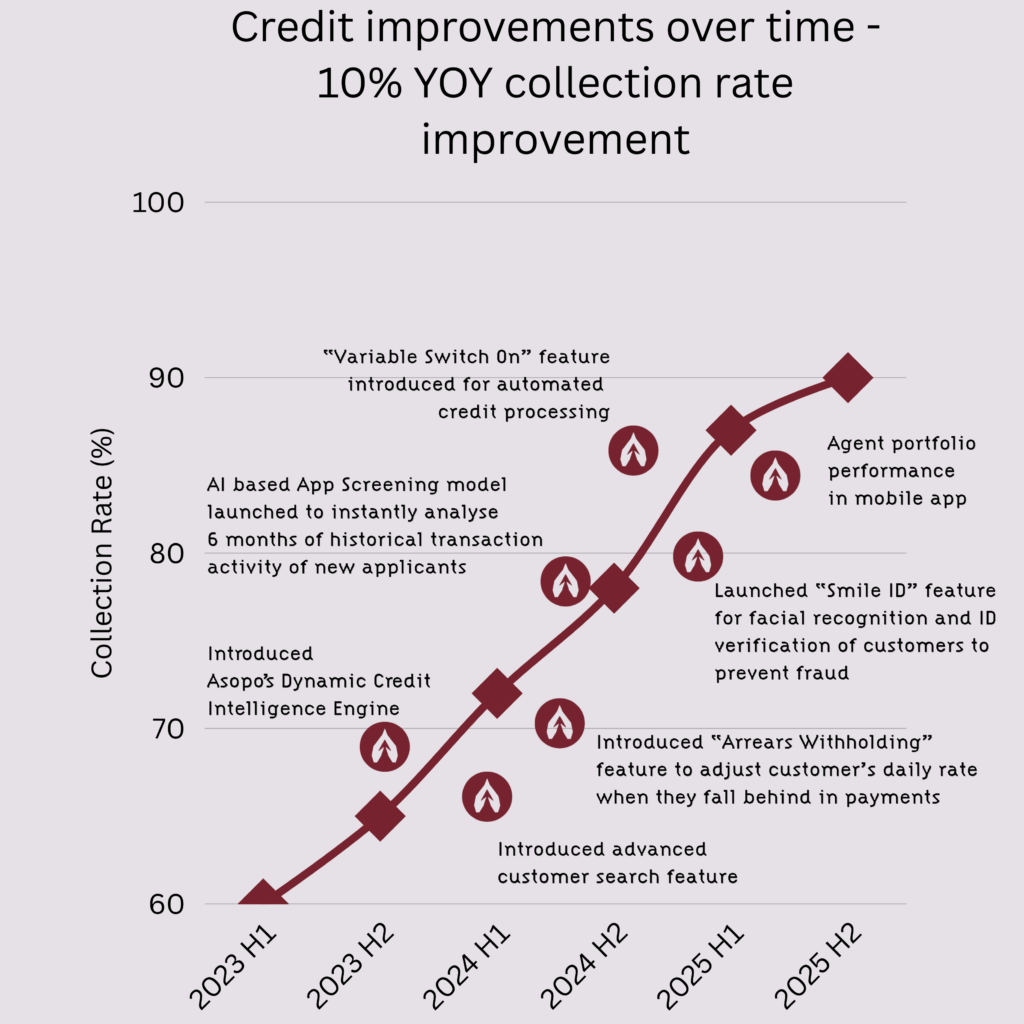
The organisations that can transform repayment behaviour into credit insight, automate collections, forecast liquidity, optimise field operations and make faster decisions will outperform those relying on disconnected systems and retrospective reporting.
Infrastructure is no longer a back-office consideration.
It’s becoming a strategic advantage.
Why This Matters for Digital Lenders, MFIs and Embedded Finance
Digital lenders are evolving beyond cash loans into device finance, SME lending and embedded credit. Their success increasingly depends on payment intelligence, AI-powered credit decisions and portfolio visibility rather than loan origination alone.
Microfinance institutions are modernising decades-old operating models by combining mobile money, digital field operations and behavioural credit intelligence to improve portfolio quality while serving more customers.
Telecom operators, retailers and utilities are also becoming financing businesses, embedding financial services directly into the products their customers use every day.
Different industries.
One operational challenge.
Why We Built Asopo
This is the challenge Asopo was designed to solve.
Rather than creating another loan management system or another CRM, we built an operational infrastructure layer that brings together mobile money, KYC, AI-powered credit intelligence, asset lifecycle management, field operations, enterprise reporting and API-first integrations within a single platform.
The result is a platform that enables organisations to launch, manage and scale financed businesses without rebuilding their technology every time they introduce a new product, enter a new market or expand into a new sector.
Whether you’re a digital bank, an MFI, an asset finance provider or a telecom operator, the underlying challenge remains the same: turning operational complexity into scalable growth.
The Future Will Be Built on Infrastructure
The next billion consumers will not gain access to financial services because there are more banks.
They will gain access because thousands of organisations are embedding finance into everyday products and services.
The winners won’t simply be those with the most customers or the largest balance sheets.
They’ll be the organisations with the infrastructure to operate intelligently, scale confidently and adapt continuously.
Financial inclusion has always been about expanding access.
The next chapter is about building the infrastructure that makes that access sustainable.